

 Print
PrintFrequently Asked Questions
In order to serve you better, Icron’s Customer Support team continues to compile a list of Frequently Asked Questions. If you would like to obtain additional technical information or support, please visit our Tech Support web page.
-
- Analog Devices Completes Acquisition of Maxim Integrated on August 26, 2021
- What is USB?
- What is ExtremeUSB®?
- USB Extenders
- SwitchableUSB™ and Simultaneous Users Interaction
- Icron’s Level VI Power Adapter and New Packaging FAQ or Level VI Power Adapter and OEM Packaging FAQ
- USB Extender Product Series Differences
- USB and Video Extenders
Q: What is USB 1.1?
A: USB 1.1 provides support for two interface speeds: Low-Speed at 1.5 Mbps and Full-Speed at 12 Mbps. The two interface speeds target specific classes of devices to provide the most efficient and cost-effective interconnect solution. Low-Speed devices are typically interactive input devices such as keyboards, mice or game controllers. Full-Speed devices are typically application specific input devices such as microphones, cameras and printers.
Q: What is USB 2.0?
A: USB 2.0 was developed to offer a complementary High-Speed transfer rate at 480 Mbps. Backwards compatible with the full speed and low speed transfer rates of USB 1.1; USB 2.0 delivers a significant bandwidth increase. USB 2.0 will continue to provide cost effective and convenient peripheral connectivity. Typical High-Speed devices are External Hard Drives, Flash Drives, Web Cameras and Scanners.
Q: What is USB 3.0/3.1/3.2?
A: USB 3.0/3.1/3.2 Gen 1 Super-Speed systems will provide a performance enhancement of speeds up to 5Gbps with distances up to 3 meters for newer storage and multimedia devices, greatly improving transfer times for large files and blocks of data. USB 3.0/3.1/ 3.2 Gen 1 devices and controllers are designed to be backwards compatible with USB 2.0 devices and controllers. For example, you can plug in a USB 3.0/3.1/3.2 Gen 1 device into a USB 2.0 controller port, or you could plug in a USB 2.0 device into a USB 3.0/3.1/3.2 Gen 1 controller port. However, the new USB 3.0/3.1 Type-B plug has been designed to only attach to USB 3.0/3.1/3.2 Gen 1 receptacles and devices.
Q: What is ExtremeUSB®?
A: ExtremeUSB was developed and patented by Icron to enable native USB connections to extend beyond the desktop, breaking through the 5m cable length limitation imposed by the USB standard. The ExtremeUSB® protocol manages the strict timing requirements of the USB specification to enable USB connections over any physical media.
Q: What are “LEX” and “REX”?
A: These are Icron terms. LEX stands for Local Extender and REX stands for Remote Extender. These two units comprise a standard Icron Extension solution. The LEX unit interfaces to the Host computer via a Type-B USB connector, or a built-in Type-A USB cable. The LEX interfaces to the REX unit over the extension media (CAT 5e/6/7 UTP, Fiber, etc.) and the REX unit provides connectivity for one or more USB devices at the remote location.
Q: Can I daisy-chain ExtremeUSB® systems together for longer reach?
A: No. ExtremeUSB systems cannot be daisy-chained by connecting multiple systems in series (i.e. LEX to REX to LEX to REX, etc.).
Q: Are your extenders rugged enough for use in an industrial energy chain?
A: Although our extenders will work with energy chains, they have not been tested for longevity in this application. Please contact Icron to discuss your project.
Q: Do my extenders need a driver?
A: ExtremeUSB is designed to be truly Plug-and-Play, and appears completely transparent to the host computer. No drivers are required.
USB Extenders
Q: What are the power requirements of my USB extender?
A: The table below provides details regarding power consumption of Icron’s USB products.
| Product | Power | Current | USB Ports |
| USB 1.1 Rover® 1850 | Bus-Powered | N/A | 1 |
| USB 1.1 Rover® 2850 | Bus-Powered | N/A | 1 |
| USB 2.0 Ranger® 2301 | 5V on REX | 3A | 1 |
| USB 2.0 Ranger® 2301GE-LAN | 5V on REX | 3A | 1 |
| USB 2.0 Ranger® 2311 | 24V at Local or Remote | 1A | 1 |
| USB 2.0 Ranger® 2312 | 24V at Local or Remote | 1A | 2 |
| USB 2.0 Ranger® 2304 | 24V on REX | 1A | 4 |
| USB 2.0 Ranger® 2304GE-LAN | 24V on REX | 1A | 4 |
| USB 2.0 Ranger® 2304PoE | PoE+ or 24V on LEX and REX | 1A | 7 |
| USB 2.0 Ranger® 2324 | 24V on REX | 1A | 4 |
| USB 2.0 Ranger® 2344 | 24V on REX | 1A | 4 |
| Icron USB 3-2-1 Raven™ 3104 | 24V on LEX and REX (Locking) | 1A on LEX, 2.71A on REX | 4 |
| Icron USB 3-2-1 Raven™ 3104 Pro | 24V on LEX and REX (Locking) | 1A on LEX, 2.71A on REX | 4 |
| Icron USB 3-2-1 Raven™ 3124 | 24V on LEX and REX (Locking) | 1A on LEX, 2.71A on REX | 4 |
| Icron USB 3-2-1 Raven™ 3204C | 24V on LEX and REX (Locking) | 1A on LEX, 2.71A on REX | 4 |
| Icron USB 3-2-1 Raven™ 3204C Pro | 24V on LEX and REX (Locking) | 1A on LEX, 2.71A on REX | 4 |
| Icron USB 3-2-1 Starling™ 3251C | Bus-Powered, Optional 5V on LEX | 3A | 1 |
| USB 3.0 Spectra™ 3001-15 | Bus-Powered | N/A | 1 |
| USB 3.0 Spectra™ 3022 | 24V at Remote (Locking) | 1A | 2 |
Q: Can I use my own power supply?
A: No. Only the Power Supply included with the product is covered by warranty.
Q: What is the difference between Raven 3×04 and Raven 3×04 Pro models?
A: Built for more demanding video extension applications, the USB-3-2-1 Raven 3204C Pro and Raven 3104 Pro is a premium extension solution, offering advanced features, higher resolution, and support for ISO transport devices and modes. For more specifics, refer to Icron’s USB 3-2-1 Raven Series Product Comparison.
Q: What is the difference between the Raven series models?
A: The Raven 3204C Series is the newest generation of CATx/LAN Raven extenders. Refer to Icron’s USB 3-2-1 Raven Series Product Comparison to compare the different feature sets.
Q: For Starling 3251C, can I use my own link cable? Can I field terminate the included cable?
A: No. You must use the included cable as it has been customized for use with the Starling. You cannot modify the included custom cable.
Q: For Starling 3251C, does it support USB Power delivery or USB-C Video (DisplayPort Alt Mode)?
A: No. The Starling 3251C only supports USB Data, and does not provide power on the USB-C connection to the host.
Q: For Starling 3251C, the Power LED is amber. Do I need to purchase the optional power supply?
A: Possibly. If your USB device connected to the REX is bus-powered, you may want to connect the optional Starling power supply to guarantee operation. If the device connected to the REX is powered from its own power supply, you do not need to. The best practice is to test the application first for consistent operation.
Q: What is the difference between the Raven and the Starling series of extenders?
A: The Raven extenders can be field terminated to specific lengths using standard RJ45 connections. The Starling extenders must use the included custom cable. Furthermore, Raven Series extenders must be powered externally at the LEX and REX, while Starling extenders can be USB bus-powered.
Q: Are any Icron products Plenum-rated?
A: Yes. The Starling 3251C (01-00457) is Plenum-rated. The Spectra 3001-15 is not plenum rated. For any of our other extension solutions you have the option of connecting the LEX and REX units with Plenum-rated CATX or Fiber Cable.
Q: Do the USB 3.0 Spectra™ 3001-15 and 3022 support USB 2.0 or 1.1 devices?
A: No, both Spectra extenders are designed to only support USB 3.0 devices.
Q: Do the USB 3.0 Spectra™ 3001-15 and 3022 support industrial machine vision cameras?
A: Yes. In fact, both Spectra extenders have had their interoperability validated by most major vision camera manufacturers including Acamar, Basler, Hamamatsu Photonics, JAI, Lumenera, NET New Electronic Technology, Pleora, Point Grey, The Imaging Source, Sensor Technologies, Sentech, The Imaging Source, Toshiba Teli Corporation and XIMEA.
Q: What USB 3.0 extender should I use with my Kinect for Xbox One?
A: We recommend the Spectra 3001-15 active cable since the Spectra 3022 is not optimized for the Kinect. The Spectra 3001-15 will provide 15m extension.
Q: Can you attach an external USB hub to the extender?
A: Yes you can. All our extenders are compatible with USB hubs.
Q: Can your USB extenders operate through a standard Ethernet hub, switch, or router?
A: Our USB 2.0 Ranger® 23xx series has select models that are able to extend USB through an Ethernet hub or switch (i.e. extend through the same local area network). None of our extenders are capable of extending USB through a router (i.e. extend from one network to another). The table below depicts this in a visual format.
| Product | Point-to-Point | Over LAN |
| USB 1.1 Rover® 1850 or 2850 | X | |
| USB 2.0 Ranger® 2300 series | X | |
| USB 2.0 Ranger® 2301 | X | |
| USB 2.0 Ranger® 2301GE-LAN | X | X |
| USB 2.0 Ranger® 2311 | X | |
| USB 2.0 Ranger® 2312 | X | |
| USB 2.0 Ranger® 2304 | X | |
| USB 2.0 Ranger® 2304GE-LAN | X | X |
| USB 2.0 Ranger® 2304PoE | X | X |
| USB 2.0 Ranger® 2324 | X | |
| USB 2.0 Ranger® 2344 | X | |
| Icron USB 3-2-1 Raven™ 3104 | X | |
| Icron USB 3-2-1 Raven™ 3104 Pro | X | |
| Icron USB 3-2-1 Raven™ 3124 | X | |
| Icron USB 3-2-1 Raven™ 3204C | X | |
| Icron USB 3-2-1 Raven™ 3204C Pro | X | X |
| Icron USB 3-2-1 Starling™ 3251C | X | |
| USB 3.0 Spectra™ 3001-15 | X | |
| USB 3.0 Spectra™ 3022 | X |
Q: Will your extenders work on a Raspberry Pi?
A: Even though we do not formally support Raspberry Pi, we have seen our extenders work successfully. However, please test it with your particular application.
Q: Is the data between your LEX and REX encrypted?
A: No.
Q: What USB data traffic types do you support?
A: We support all four USB data traffic types: Control, Interrupt, Bulk, and Isochronous.
Q: Does the USB 2.0 Ranger 2300 series use the same power supplies that the 2200 series did?
A: The same 5V and 24V power supplies are used for both the 2200 and 2300 series, but please check to see which model uses 5V versus 24V (example – the 2204 used 5V while the 2304 uses 24V).
Q: What is the USB device limit for your USB extenders?
A: The USB 2.0 Ranger® 2300 series extenders can support up to 31 USB devices or hubs, and the USB 2.0 Ranger® 2200 series extenders can support up to 15 USB devices or hubs.
Q: What is the maximum bandwidth per extender port?
A: All devices connected to the REX will share the maximum USB bandwidth. A one port extender will provide full bandwidth to that port while a four port extender will share among the four.
Q: Does your new USB 3-2-1 Raven support four USB 3 devices at the same time?
A: Yes. The bandwidth will be shared by all four devices whether they are all USB 3 or a combination of USB 3.1, 2.0 and/or 1.1 as the Raven Series is backward compatible to USB 2.0/1.1.
Q: I want an extender that can connect to a LAN in which various users can access USB devices. Do you support this?
A: Yes. We have two features called SwitchableUSB™ and Simultaneous Users Interaction that may be of interest. See more on these below.
Q: Do your LAN based extenders support auto IP assignment?
A: Yes they do.
Q: What does a blinking host LED mean?
A: The USB extender is in suspend mode. Hubs are placed in suspend mode by an operating system when no USB devices are connected. The hub will wake up from suspend mode when a USB device is connected.
Q: How can I upgrade the firmware on my USB extender?
A: To upgrade the USB 2.0 Ranger® 2300 extender series or 2201, 2204, 2212, 2224, or 2244 extenders, please contact Icron’s Tech Support. The extender can be programmed in-field by the user.
There are no upgrades available for the USB 1.1 Rover® 1850/2850 or USB 2.0 Ranger® 2211 products.
Q: What type of CAT 5e/6/7 cable is required for my product?
A: All CAT X extender models require at least solid-core CAT 5e UTP for extension distances longer than 10 meters. For Raven, Maverick and KVM extenders, we recommend CAT 6a/7 cabling.
Q: What is the CAT 5e/6/7 pin out for my product?
A: The CAT 5e extender models use all four pairs of the UTP cable. They all use a standard straight-through connection, referred to as TIA/EIA-568-B.1-2001 T568A or T568B.
Q: For your Fiber based extenders, can I switch the SFP module from Multimode to Singlemode and vice versa?
A: Our Ranger/RG 2324 (multimode) and 2344 (singlemode) extenders are the same except for the transceivers. However customers should only use the transceivers provided by Icron to ensure proper performance. The Spectra 3022 is a multimode only model as is the USB 3-2-1 Raven 3124. The USB 3-2-1 Starling 3251C is a bus-powered extender and has optional 5V power on the LEX that works with Icron’s power supply, available for purchase separately (21-00111). The USB 3-2-1 Raven Series extenders are powered at both the LEX and REX.
Q: What powering options are available in your extender models?
A: The USB 1.1 Rover® series extenders are all bus-powered (power is supplied by the host computer). The USB 2.0 Ranger® 2301 and 2304 Series, USB 2.0 Ranger® 2324 /2344, and the USB 3.0 Spectra™ 3022 are all powered by a power supply on the REX. The USB 2.0 Ranger® 2311/12 can be powered by a power supply at either the LEX or REX.
Q: How do I ground my USB extenders?
A: There are four mounting holes on the bottom of the silver or black enclosure of the USB 3.0 Spectra/SP3022 and USB 2.0 Ranger/RG2300 Series. If your installation mandates grounding of the extender system enclosures, please refer to the instructions below. Both the local and remote extender units would need to be grounded. Note, while grounding does not impact the performance of the product, do not ground the extender units unless specified by your installation requirements.
Materials Required:
- 2 x M3.0 4mm Screws
- 2 x Crimp Connectors
- 2 x Wires (select size to accommodate your use case)
- 1 x Screwdriver
Step 1: Turn local extender unit over to expose unit’s four mounting holes.
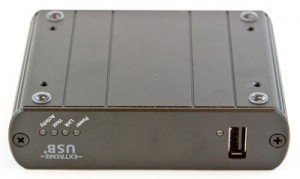
Step 2: Attach crimp connector to wire and place over one of the mounting holes. Insert screw and tighten.
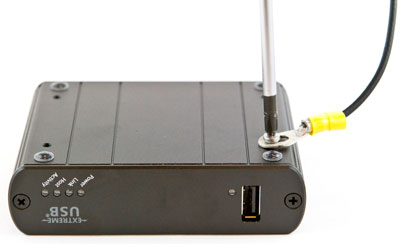
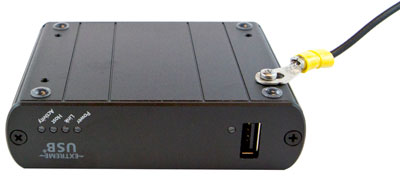
Step 3: Ensure connection is secure, and attach the other end of the wire to your ground source. Repeat these same steps for remote extender unit.
SwitchableUSB™ and Simultaneous Users Interface
Q: What is SwitchableUSB?
A: SwitchableUSB is a protocol developed by Icron to dynamically switch LEX and REX pairings over a LAN. This is done on a 1:1 LEX to REX fashion.
Q: I want to have multiple USB devices in multiple locations connected to a single host. Can I connect one LEX to two or more REX units?
A: This is supported through an OEM feature called Simultaneous Users Interaction. Refer to next question.
Q: What is Simultaneous Users Interaction?
A: Simultaneous Users Interaction is an Icron feature for OEM customers enabling up to seven different users in seven different locations to collaboratively view and make changes to a document or image at the same time over a LAN. The set-up is one LEX connected via LAN up to seven different REXs. Please contact your Account Manager for more information.
USB Extender Product Series Differences
Icron has produced a number of different USB 1.1, 2.0 and 3.1 extender solutions. Newer extenders have been designed to replace older versions of the extenders, and the differences between the older and newer products are listed below.
Q: What are the differences and advantages between the USB 2.0 Ranger® 2200 and USB 2.0 Ranger® 2300 product series?
A: The USB 2.0 Ranger® 2300 product series is our latest USB 2.0 extension platform and allows for extending USB over a Local Area Network, integrating SwitchableUSB™ control for OEM customers with increased hub compatibility. The 23xx series includes our patented Mass Storage Acceleration feature allowing mass storage transfers to maintain a throughput rate close to 80% of what would normally be available if directly connected. Moreover, two of the models (2301GE-LAN and 2304GE-LAN) can additionally extend over a Local Area Network.
Q: Are the USB 2.0 Ranger® 2300 extenders compatible with your existing USB 2.0 Ranger® 22xx series?
A: No. The new 23xx series uses our latest ExtremeUSB ASIC and is not compatible with the older 22xx series.
Q: Will the 23xx series cost more than the 22xx series?
A: No, in fact the 23xx equivalent models cost slightly less and have more functionality. Please contact your Account Manager for more details.
Q: Can I still purchase USB 2.0 Ranger® 2100 and USB 2.0 Ranger 2200 product series?
A: The USB 2.0 Ranger 2100 series was discontinued in 2013 (read our End of Life notification) and has been replaced with the newer USB 2.0 Ranger 2300 series to take advantage of all the latest features and functionality.
USB and Video Extenders
Q: What are the power requirements of my USB and Video Extender?
A: The table below provides details regarding power consumption of Icron’s USB and Video products.
| Product | Voltage | Current | Power |
| EL5100 | LEX: 5V REX: 5V | LEX: 3A REX: 3A | LEX: 15W REX: 15W |
| EL5200 | LEX: 5V REX: 5V | LEX: 3A REX: 3A | LEX: 15W REX: 15W |
Q: Can I use my own power supply?
A: No. Only the Power Supply included with the product is covered by warranty or sold by Icron as an optional accessory.
Q: Why can I not select a support resolution when using my USB and Video Extender?
A: Either the latest video drivers are not installed, or the resolution is not supported. If the specific resolution is not listed by the monitors EDID, or is not supported by the USB and Video Extender, it will not operate.
Q: What cable is recommended for best performance with the EL5353 or EL5363?
A: Icron recommends CAT 6/6a U/FTP or better cabling with solid core conductors and CAT 6/6a rated RJ45 jacks. That is, CAT 6 or 6a, with pair shielding. At minimum, standard CAT 5e UTP cable can be used but it must have solid core conductors and requires a very good environment and good installation practices, such as having no loops in the cable, ensure it is not placed near other cables or power lines, and that it is properly terminated with CAT 5e RJ45 jacks.